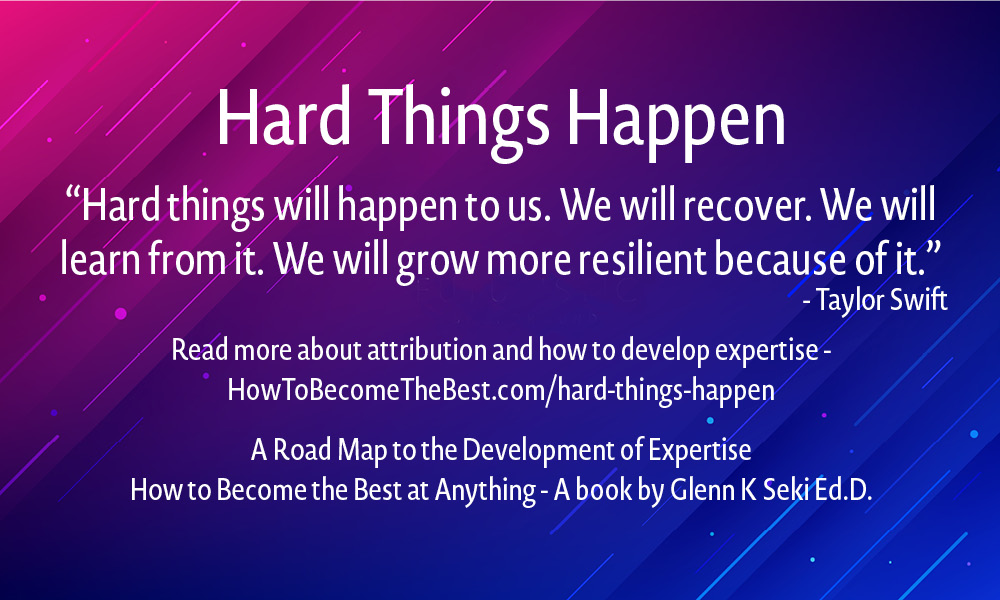
“Hard things will happen to us. We will recover. We will learn from it. We will grow more resilient because of it.” – Taylor Swift
An excerpt from How To Become The Best at Anything, Chapter 9, Persistence, Motivation, and More About Your Path
A lot will depend on to what you attribute a failure or poor performance.
When you do well at something, what do you attribute it to? Do you think it was luck or do you think it was because you worked hard? Chance can always play a part in life, however, becoming the best is about hard work. If you did well at something it was probably due to your hard work and being prepared. You put in the deliberate practice and you did well.
When you don’t do well, when you fail, when you can’t seem to get it right, what do you attribute it to? Do you think it was bad luck or was it because someone had something against you? If you blame a poor performance on an external source, not yourself, you feel powerless. You feel like there is nothing you can do about it. You become frustrated, depressed; you lose your self-confidence. However, if you think, I wasn’t prepared enough, I can do better, I just need to keep working, then you have control over the situation, you can do something about it. Use the failure to motivate yourself to do better.
Just like you attribute success to your being prepared and working hard, you should attribute failure to yourself, take control, and figure out what you need to practice so it doesn’t happen again. YOU are in control of your successes and failures.
Sometimes you will feel tired or bored. You don’t feel like practicing. You need to remember that these practice sessions will help you reach your goal. Think: I need to practice, I want to practice, practice is good!
In the section, “Along the Path,” sub-goals or summative assessments were markers of your mastery of a skill, knowledge, understanding, etc. Use these accomplishments as motivation to keep practicing. Celebrate them.
Be engaged in your own learning. Observe yourself, judge yourself, and react positively to your outcomes, even when you fail. Don’t rely on your coach or others for your learning. You have to be involved. You have to observe your practice and performance, you have to judge your practice and performance, and you have to be positive, even when you fail. You know when you fail, you are in control and you will do better. The failure just indicated where you need to put in more practice.